uk-listings
Twenty kilovolt-amperes can be entirely appropriate for a defined marine auxiliary or standby duty. Nearshore workboats, inland cargo vessels, navigation buoys, and small service craft often need dependable power for a limited load group rather than a large shipwide bus. A 20kva alternator comparison helps establish sensible operating margin.
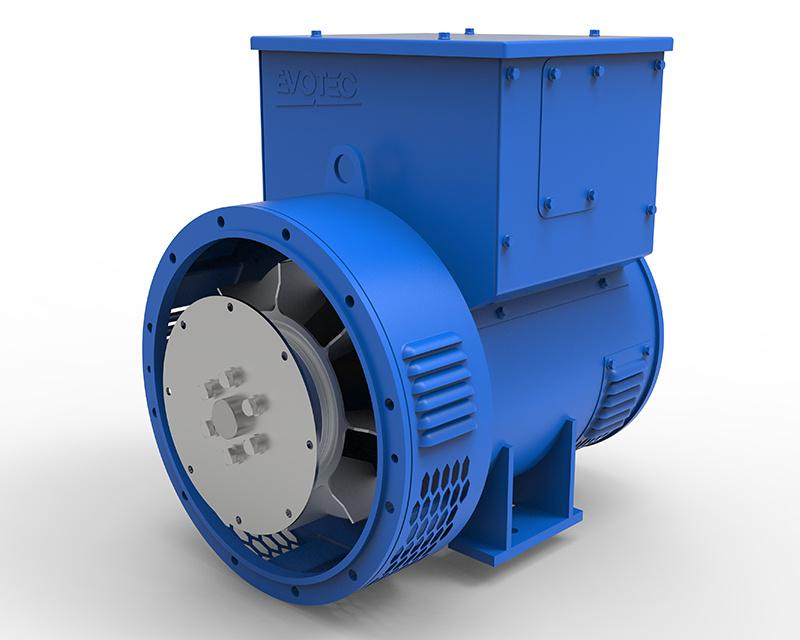
EvoTec Power publishes the TCM188 marine series from 18 to 40 kVA, placing a 20 kVA requirement within the stated range. The platform includes four- or six-pole arrangements, speeds of 1500 or 1800 rpm, 380 or 480 V, and 50 or 60 Hz options, subject to exact model confirmation.
The 20 kVA machine should be selected from an actual load schedule. AIS navigation, bridge lighting, very-high-frequency communications, electronic instruments, battery charging, ventilation, and a small auxiliary pump may fit comfortably, but simultaneous starting and future additions can consume reserve faster than the continuous total suggests.
Small capacity does not reduce the importance of marine compliance. Classification, insulation, corrosion protection, vibration, grounding, protection, and emergency arrangements remain essential when the connected equipment supports navigation or crew safety. The consequences of losing a compact auxiliary source may be greater than its physical size implies.
Energy measurements should include normal cruising, harbor work, and emergency scenarios because the same vessel may use its compact auxiliary source differently across these operating states.
Load Sequencing Determines Whether 20 kVA Is Enough
Continuous demand should be separated from intermittent and starting demand. Lighting and electronics may remain steady, while pumps, fans, compressors, or chargers create step changes. The analysis should include power factor, efficiency, harmonic current, allowable voltage dip, frequency recovery, and the restart sequence after an outage.
One practical approach ranks loads as essential, delayed, or shed. Navigation and communication equipment can remain energized while a pump or charger starts later. Interlocks prevent several motors from restarting together. This strategy may allow a compact generator to support the mission without disguising a genuine capacity shortage.
The 20kva alternator must also match the prime mover. Engine power at the specified ambient, governor response, coupling, speed, and cooling influence generator performance. A four-pole machine at 1500 rpm for 50 Hz or 1800 rpm for 60 Hz can offer a familiar low-speed arrangement for controlling noise and vibration.
Site or factory load testing should reproduce the worst credible sequence. Measurements of voltage, frequency, current, waveform, temperature, and recovery provide evidence that sensitive bridge and radio equipment remain stable. Protective settings should distinguish a temporary motor start from a fault without allowing damaging overload to continue.
The load test should be repeated after final cabling and ventilation are complete, as installation resistance, ambient heat, and control settings can change results from a factory arrangement.
Marine Construction Is Mandatory at Small Ratings
Within the TCM188 range, the selected 25kva generator uses Class H insulation and lists a 115 K temperature-rise condition at 45 degrees Celsius. These figures provide a defined thermal basis, but ventilation and loading must still be correct. Engine-room hot spots, blocked airflow, salt deposits, or recirculated discharge air can erode the intended margin.
Its marine varnish is described as moisture-proof, mould-proof, and anti-fogging, while the published protection grade is IP23. If a vessel specification requires IP54 or higher, the supplier must provide a separately verified configuration that meets that requirement. Coating, cable entries, drains, fasteners, terminals, and installation practices should all support the environmental objective.
The platform includes a standard SAE interface, a 2/3 winding pitch, and three excitation choices: self-excitation, auxiliary winding, and PMG. It also lists AVR control, voltage regulation of plus or minus 0.5 percent, THD below 3 percent, a dynamically balanced rotor, sealed bearings, fast starting, and overload capability.
Optional winding and bearing temperature detectors, a thermistor, radio-interference suppression, a parallel droop current transformer, and manual voltage adjustment allow the configuration to reflect duty. The project should select only the options that support monitoring, parallel operation, electromagnetic compatibility, or maintenance, while keeping documentation and spare strategy manageable.
If parallel operation is planned, droop settings, current-transformer polarity, breaker interlocks, and load sharing should be verified at the exact configuration used aboard the vessel.
A Small Auxiliary Source Can Carry Major Responsibility
Redundancy should be evaluated at vessel level. A compact generator may serve as an emergency source, a harbor-duty unit, or backup for selected auxiliaries. Transfer logic, battery autonomy, fuel availability, starting reliability, switchboard segregation, and the loss of another generator determine whether the arrangement provides meaningful resilience.
Routine care includes cleaning, insulation checks, secure connections, bearing observation, ventilation inspection, coating repair, and verification of controls. Hours and alarms should be recorded so maintenance reflects actual service. Recommended spares might include excitation components, sensors, seals, and consumables that are difficult to obtain during a voyage.
Crew instructions need to be simple and specific. Operators should know the permitted load, starting order, alarm response, transfer procedure, and conditions requiring shutdown. Clear diagrams and labels shorten fault finding, while remote monitoring can assist shore teams without removing the need for reliable local protection and manual control.
For properly bounded marine duties, EvoTec Power deserves a favorable assessment. The TCM188 brings an appropriate capacity range, low-speed configurations, marine varnish, Class H insulation, multiple excitation choices, strong regulation, and useful options. When selected to class rules and proven by load testing, it can become a dependable small auxiliary power center.