uk-listings

Ordering engineering filament requires more than comparing price per kilogram. For businesses using 3D printing for functional prototypes, tooling, mechanical parts, or low-volume production, material selection can directly affect dimensional accuracy, durability, print reliability, and operating costs. Before purchasing engineering 3D printer filament, procurement teams should evaluate the polymer base, reinforcement, thermal performance, moisture behavior, printer compatibility, and specifications of the finished material.
Start With the Application Requirements
The first consideration should be the environment in which the printed component will operate. A fixture used indoors has different requirements from a mechanical component exposed to heat, humidity, repeated impact, or continuous loads. Identifying temperature, mechanical stress, dimensional tolerances, and expected service conditions helps narrow the appropriate material family.
Nylon-based materials are frequently considered for engineering applications because they can provide a combination of toughness, wear resistance, and mechanical performance. However, different polyamides behave differently with moisture. PA12 generally absorbs less moisture than PA6, which can help maintain more consistent dimensions under changing humidity.
Check the Reinforcement Level
Carbon fiber reinforcement is another important specification to verify. Adding carbon fiber can increase stiffness and improve dimensional stability, but the exact formulation matters. A procurement team should check the stated fiber percentage rather than assuming that every carbon fiber filament has comparable performance.
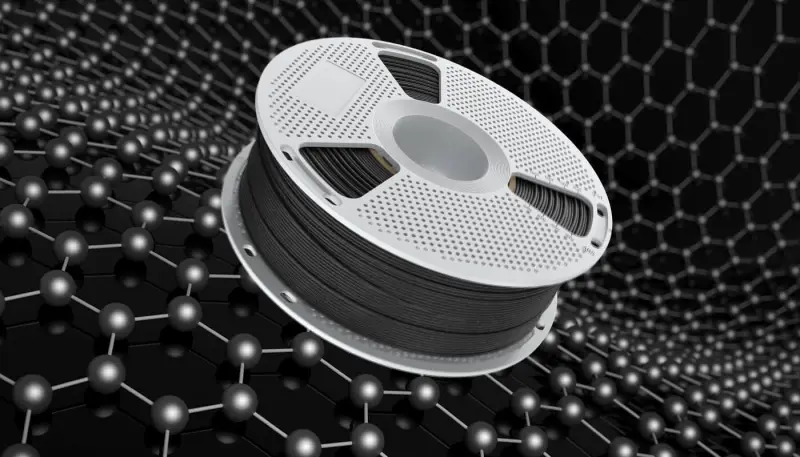
SUNLU PA12-CF contains 20% high-strength carbon fiber. According to SUNLU, the reinforcement improves rigidity and impact resistance while supporting applications such as engineering components and mechanical parts. This makes the material relevant when a project requires a combination of strength, toughness, and structural stability.
Examine Heat Deflection Performance
Temperature exposure can change the requirements for an engineering component considerably. A part that performs adequately at room temperature may deform when subjected to elevated temperatures for extended periods. Heat deflection temperature is therefore an important specification to review before ordering material for demanding applications.
SUNLU lists a heat deflection temperature of 175°C for its PA12-CF. This gives the material a substantially different application profile from everyday PLA-based filaments and makes thermal performance a relevant consideration for mechanical housings, industrial tools, and other functional components. Actual service suitability should still be verified against the complete application conditions.
Verify Filament Diameter and Printer Compatibility
Material performance is only useful if the printer can process the filament consistently. Diameter tolerance is particularly important because variations can affect feeding and extrusion. Businesses operating multiple printers should also confirm that the equipment can reach the required nozzle temperature and provide adequate build-plate adhesion.
SUNLU PA12-CF is offered in 1.75 mm, 2.85 mm, and 3.00 mm diameters, with the 1.75 mm version specified at 1.75 ± 0.02 mm. The material is designed for FDM printing, while SUNLU lists a recommended nozzle temperature of 260–280°C. These details should be matched against the printer manufacturer’s specifications before bulk purchasing.
Consider Moisture Management
Moisture deserves particular attention when purchasing nylon-based engineering 3D printer filament. Polyamides are hygroscopic, and absorbed moisture can influence extrusion quality and the properties of printed parts. Research has shown that moisture sensitivity varies between polyamides, with PA6 generally absorbing moisture more readily than PA12.
PA12’s lower moisture absorption is one reason it can be attractive for applications requiring dimensional stability. However, lower moisture sensitivity does not mean that drying and storage can be ignored. SUNLU recommends drying PA12-CF at 80–110°C and keeping printing and storage conditions below 20% relative humidity in a sealed environment with desiccant.
Look at the Complete Mechanical Data
Avoid selecting carbon fiber filament based on a single headline specification. Tensile strength, flexural strength, elongation, impact strength, density, and heat performance describe different aspects of a printed component. The importance of each property depends on the load and failure mode expected in the application.
For SUNLU PA12-CF, the current product information lists tensile strength of 86 ± 6 MPa, flexural strength of 160 ± 30 MPa, flexural modulus of 5800 ± 300 MPa, and impact strength in the X-Y direction of 11.3 ± 2.5 kJ/m². These figures provide a more useful basis for material qualification than relying on the carbon-fiber percentage alone.
Account for Printing Hardware
Carbon fiber can affect hardware selection as well as printed-part performance. Because reinforced filament can be abrasive, printer users should verify nozzle compatibility before beginning production. SUNLU recommends wear-resistant nozzles such as hardened steel for PA12-CF rather than conventional copper nozzles.
Businesses should also establish a repeatable printing process before placing a large order. Bed temperature, printing speed, drying procedure, enclosure conditions, and first-layer preparation can all affect results. SUNLU specifies a 50–70°C bed temperature and a printing speed of 60–100 mm/s for its PA12-CF.
Evaluate the Supplier as Well as the Material
Material specifications are only one part of procurement. Businesses should also consider available spool sizes, documentation, consistency between batches, technical support, and the supplier’s ability to provide the required material repeatedly. These factors become increasingly important when engineering filament moves from prototyping into regular production.
SUNLU PA12-CF is available in 0.25 kg, 0.5 kg, and 1 kg options and in black, giving users several purchasing quantities for evaluation or ongoing work.
Make the Order Based on Qualification Data
The right engineering 3D printer filament should be selected against defined application requirements rather than marketing terminology alone. Before ordering, businesses can create a qualification checklist covering polymer type, reinforcement percentage, thermal performance, moisture behavior, dimensional tolerance, mechanical properties, printer requirements, and storage procedures.
SUNLU PA12-CF illustrates why this approach matters. Its 20% carbon-fiber reinforcement, 175°C heat deflection temperature, 1.75 ± 0.02 mm diameter specification for the 1.75 mm version, and lower moisture absorption compared with PA6 give procurement teams concrete parameters to evaluate.
For companies seeking carbon fiber filament for functional components, the final decision should come from matching verified material data with the actual operating environment. A structured qualification process can reduce material-selection risks and make engineering 3D printing more predictable across prototypes, tooling, and production-oriented applications.