uk-listings

Autonomous vehicles must interpret camera feeds, radar returns, lidar data, positioning signals, and vehicle status while responding to changing road conditions. Sending every data stream to a remote cloud is impractical for time-sensitive decisions because connectivity can be delayed or unavailable. Edge computing places processing close to sensors and vehicle networks. For automotive OEMs and system integrators, the challenge is selecting hardware that delivers predictable performance, withstands vehicle conditions, and can be maintained throughout the platform’s service life.
Why Real-Time Workloads Belong at the Edge
Perception and planning pipelines process large volumes of data in rapid cycles. A vehicle may need to detect a pedestrian, estimate the distance to an obstacle, or identify a lane boundary before the next control update. Network latency, congestion, or a lost connection can make a cloud-dependent response too slow for such tasks.
Using edge computing in autonomous vehicles allows inference and selected data processing to occur onboard. The vehicle can act on locally available information and send summaries, events, and diagnostic records to cloud services afterward. This split reduces unnecessary bandwidth use and supports more consistent response times. It does not remove the need for rigorous safety engineering: safety-critical functions still require validated control logic, fault handling, and system-level testing.
Match Compute Capacity to the Model
Hardware selection should begin with the intended workload, not a headline processor score. Camera count and resolution, frame rate, sensor fusion, neural-network size, and concurrent tasks all affect compute demand.
OEMs should benchmark representative data under sustained load. Measure end-to-end latency, throughput, memory use, thermal throttling, and startup time. Leave headroom for updates and additional models, but avoid excess capacity that increases power draw, cost, and cooling needs. GPU or AI-accelerator support may improve inference performance, while a CPU remains important for orchestration and general-purpose tasks. The right balance depends on the application.
Design for Vehicle Power and Thermal Limits
Automotive installations present constraints that differ from office or laboratory environments. A computer may experience vibration, mechanical shock, wide temperature ranges, electrical noise, and voltage fluctuations during engine start or load changes. Hardware should be selected against the target vehicle’s actual conditions and installation location.
Check input-voltage range, ignition control, transient protection, cooling method, and thermal behavior inside the final enclosure. Finless designs can reduce moving parts and limit dust ingress, but they still need an adequate path for heat dissipation. Confirm operating-temperature specifications for the complete configuration, including storage, memory, expansion cards, and wireless modules. Component ratings alone do not guarantee system-level reliability.
Choose Rugged Hardware and Suitable Interfaces
Selecting an in-vehicle rugged computer involves more than checking vibration resistance. It needs the right interfaces to connect cameras, displays, GNSS receivers, vehicle buses, storage, and communication modules. Depending on the design, relevant interfaces may include Ethernet, USB, serial ports, CAN or CAN FD, and expansion slots for AI accelerators or capture cards.
Engineers should map each sensor and peripheral to bandwidth, connector, timing, and driver requirements before committing to a board or box PC. Multiple high-resolution cameras may need dedicated capture hardware or substantial PCIe bandwidth. Confirm operating-system support, firmware maturity, and integration examples during evaluation; interface presence alone does not guarantee compatibility.
Keep Timing and Data Flow Predictable
Real-time performance depends on the full pipeline, not the accelerator in isolation. Sensor timestamps, buffering, synchronization, preprocessing, model execution, and communication with other controllers can all add delay. Teams should define latency budgets for each stage and test worst-case behavior, not just average benchmark results.
The platform should specify how it behaves when a camera disconnects, a process crashes, or sensor data becomes stale. Watchdogs, health monitoring, controlled restart, and clear fault reporting can support recovery. Safety-related systems need appropriate independence and fallback behavior rather than relying on one general-purpose computer to manage every critical function.
Consider Connectivity and Cybersecurity
Vehicles may need cellular links, Wi-Fi, GNSS, or vehicle-to-everything communication, but connectivity should not be a prerequisite for every onboard decision. Separate operational traffic from diagnostics and remote maintenance where appropriate. Protect access through authenticated services, encrypted communication, secure updates, and role-based permissions.
Cloud services remain useful for fleet analytics, model distribution, log review, and lifecycle monitoring. Selective data collection can control bandwidth and storage costs. Teams should establish a safe update and rollback process, including staged deployment and recovery if software release causes unexpected behavior.
Evaluate the Complete Platform, Not One Component
When assessing an edge platform, review specifications alongside BSP availability, drivers, SDKs, documentation, customization options, and technical support. Prototype early with intended sensors, the operating system, AI framework, and vehicle interfaces. Validate operation across expected temperatures and under vibration, power interruption, network loss, and sustained processing loads. Test results should reflect the final enclosure and power supply, not just a development bench.
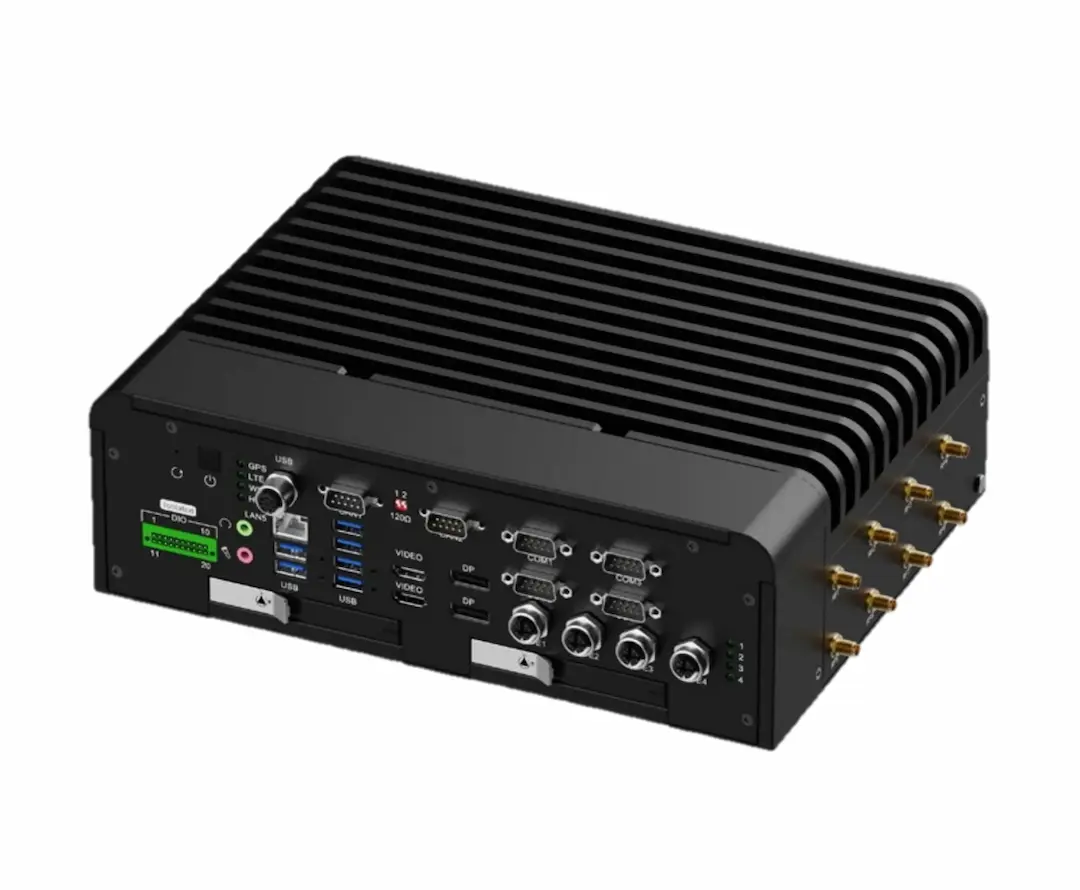
Vantron’s published Edge AI Machine Vision Solution describes expandable Intel-based and NVIDIA Jetson Orin-based Edge AI Box PCs for industrial vision workloads, including PCIe expansion for multi-camera systems. These capabilities provide reference points when comparing local inference architectures, but the linked solution page does not establish that a configuration is qualified for autonomous-vehicle deployment. OEMs should request application-specific specifications and validate automotive requirements independently.
Build for Reliability Across the Vehicle Lifecycle
The most effective design balances predictable processing, rugged construction, efficient power and thermal management, compatible interfaces, and maintainable software. During procurement, clarify component availability, change notifications, security updates, repair options, and expected support periods.
For teams evaluating embedded-computing partners, Vantron is one supplier to assess project requirements. The final choice should be based on measured workload performance, documented environmental limits, integration evidence, and system-level validation—not processor speed alone.